For generations, the school system has prioritized standardization—preparing students to memorize facts, regurgitate information for exams, and comply with rigid structures. However, to thrive in the 2030 workforce, students need more than just good memory; they need adaptability, emotional intelligence, and creativity. This is why forward-thinking platforms and institutions like Skalvi are championing a shift toward comprehensive development that values the whole child over the test score.
The Education Paradox: Memorization vs. Mastery
We are currently witnessing an education paradox. Information is universally accessible via a smartphone, yet many curricula still focus heavily on memorizing dates, formulas, and definitions. While foundational knowledge is important, the exclusive focus on it creates a “knowledge illusion,” where students appear to know a subject because they can pass a test, but lack deep comprehension or the ability to apply that knowledge in novel situations.
Parents and educators are increasingly asking: Is the traditional factory-model of education serving our children, or is it stifling their potential? The answer lies in understanding the stark contrast between the old guard of rote memorization and the progressive approach of holistic development.
Holistic Education vs Rote Learning: The Core Differences
To understand the best path forward, we must dissect the two prevailing methodologies. The battle of holistic education vs rote learning is not just about pedagogy; it is about the philosophy of human potential.
Defining Rote Learning
Rote learning is a memorization technique based on repetition. The idea is that one will be able to quickly recall the meaning of the material the more one repeats it. While useful for memorizing multiplication tables or the alphabet, rote learning drawbacks become glaringly obvious in higher-level thinking. It promotes surface-level retention. Once the exam is over, the information is often discarded by the brain as irrelevant. It discourages questioning and views the teacher as the sole source of truth.
Defining Holistic Development
In contrast, holistic education seeks to engage all aspects of the learner, including mind, body, and spirit. It is not limited to academic success but focuses on the physical, emotional, moral, psychological, and spiritual growth of the child. It emphasizes understanding over memorizing. In a holistic environment, a student doesn’t just learn that E=mc²; they explore the implications of energy and matter, perhaps through experiments or philosophical debate.
The 2030 Workforce: Why 21st-Century Skills Matter
Why does this distinction matter now more than ever? The 2030 workforce will be defined by volatility, uncertainty, complexity, and ambiguity (VUCA). Employers of the future will not ask, “What do you know?” because Google knows everything. They will ask, “What can you do with what you know?”
Automation and the Human Edge
Machines are excellent at rote tasks. Algorithms can process data faster than any human brain. Therefore, an education system based on rote learning is effectively training children to compete with robots—a competition they cannot win. 21st-century skills such as complex problem-solving, emotional intelligence, negotiation, and cognitive flexibility are the human edge. These are skills that cannot be easily automated.
Critical Thinking Over Fact Recall
Holistic education fosters critical thinking. It encourages students to analyze sources, recognize biases, and construct arguments. In a world awash with misinformation, the ability to discern truth is a vital life skill. Schools that prioritize holistic development create environments where failure is seen as a learning opportunity, not a dead end. This resilience is crucial for the entrepreneurs and innovators of 2030.
Student Agency and Experiential Learning
Two pillars of the holistic approach are experiential learning and student agency. These methodologies transform students from passive recipients of information into active participants in their own education.
Learning by Doing
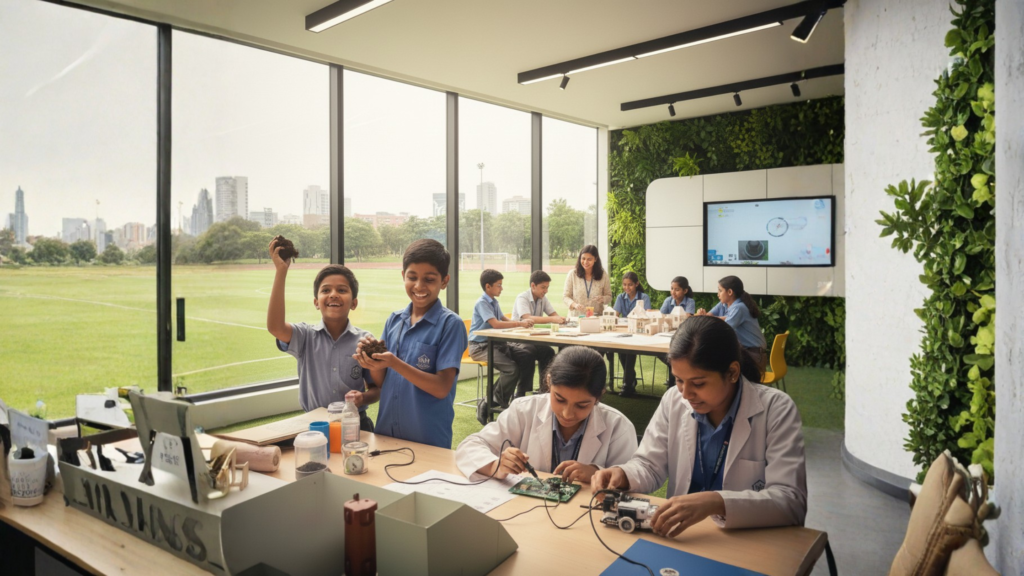
Experiential learning is the process of learning through reflection on doing. Instead of reading about botany in a textbook, students might cultivate a community garden. Instead of memorizing geometric formulas, they might design and build a model bridge. This hands-on approach ensures that knowledge is cemented through experience. It bridges the gap between theory and practice, ensuring that students can apply abstract concepts to real-world problems.
Empowering the Learner
Student agency refers to the level of autonomy and power that a student experiences in the learning environment. When students have agency, they have a voice and choice in how they learn. They learn to set goals, monitor their progress, and reflect on their learning. This fosters a sense of ownership and intrinsic motivation. A student who learns because they are curious will always outperform a student who learns solely to avoid a bad grade. Platforms like Skalvi recognize the importance of giving students the tools to navigate their own educational journeys.
Building a Future-Ready Foundation
The transition from a standardized, exam-focused system to a personalized, holistic one is not without challenges. It requires a shift in mindset from parents, teachers, and policymakers. However, the cost of inaction is too high. If we continue to rely on rote learning, we risk sending a generation of students into the world unprepared for the challenges of the 21st century.
Ultimately, the debate of holistic education vs rote learning settles on what we value most: obedience and recall, or innovation and adaptability. By embracing holistic development, we nurture individuals who are not only ready for the workforce of 2030 but are also capable of shaping it. We must prioritize environments that spark curiosity, foster empathy, and build resilience. This is the only way to ensure our students don’t just survive the future, but thrive in it.