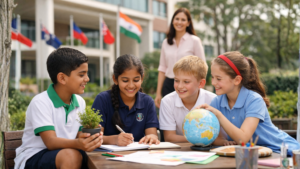
Critical thinking and problem-solving are essential skills for children to succeed academically and in life. Parents searching for skill-based learning, practical education, future-ready education, best school in Bangalore, and CBSE school in Bangalore want schools that prepare students to think independently, analyze situations, and apply knowledge effectively. Skalvi International School emphasizes fostering these skills through structured CBSE education, hands-on activities, and real-life learning experiences.
Why Critical Thinking Matters in School
Critical thinking enables students to evaluate information, make informed decisions, and approach challenges logically. Problem-solving complements this by helping children apply reasoning to real-world scenarios. Parents often prioritize future-ready education, looking for schools that nurture analytical thinking, creativity, and decision-making. Skalvi International School incorporates skill-based learning exercises to strengthen these competencies from an early stage.
Key Benefits of Fostering Critical Thinking
| Benefit | How It Helps Students |
| Analytical Skills | Students learn to assess situations and make informed decisions |
| Problem-Solving | Enables practical solutions to academic and everyday challenges |
| Confidence | Thinking independently boosts self-assurance in learning |
| Creativity | Encourages innovative approaches to tasks and projects |
| Future Career Readiness | Prepares students for higher education and professional challenges |
How Practical Education Supports Critical Thinking
Practical education bridges the gap between theory and application. Students engage in experiments, projects, and scenario-based learning, which enhances skill-based learning and real-life experience. Parents searching for practical education want children to understand concepts deeply, not just memorize lessons. Skalvi International School integrates these methods with the CBSE curriculum, enabling students to think critically and apply knowledge in meaningful ways.
Strategies Schools Use to Promote Problem-Solving
Schools can nurture problem-solving skills through structured activities, collaborative projects, and guided challenges:
- Group projects that require planning and creative solutions
- Experiments and real-life scenario exercises
- Interactive classroom discussions to evaluate multiple approaches
- Brainstorming sessions for collaborative idea generation
At Skalvi International School, these strategies are embedded in daily learning, allowing students to develop practical skills alongside academic knowledge.
Role of Teachers in Developing Critical Thinking
Teachers guide students by encouraging questions, providing feedback, and presenting challenges that stimulate thinking. A school with strong skill-based learning practices ensures every student receives guidance and opportunities to develop problem-solving skills. Parents searching for CBSE school in Bangalore often prioritize schools where teachers actively mentor critical thinking and application skills. Skalvi International School maintains a balanced teacher-student ratio to provide personalized attention.
Parent Checklist: Evaluating Schools for Critical Thinking
| Feature | Why It Matters |
| Hands-On Activities | Encourage practical application of knowledge |
| Collaborative Projects | Develop teamwork, analysis, and decision-making |
| Teacher Support | Provides guidance and feedback for skill development |
| Real-Life Scenarios | Connects lessons to everyday problem-solving |
| Assessment Methods | Evaluate thinking and application, not just memorization |
How Skill-Based Learning Enhances Problem-Solving
Skill-based learning is integral to developing critical thinking. By participating in practical tasks, collaborative projects, and real-world problem-solving, students learn to:
- Identify problems clearly
- Analyze multiple solutions
- Apply logic and creativity
- Reflect on outcomes and improve approaches
This hands-on learning prepares students for challenges in higher education and careers.
Real-Life Applications for Students
Critical thinking and problem-solving are not limited to classroom theory. Students apply these skills in:
- Science experiments and math problem-solving
- Group projects that mimic workplace collaboration
- Debates and presentations that require structured reasoning
- Everyday classroom decisions and leadership roles
Skalvi International School ensures students get continuous practice through practical education and real-life learning experiences.
Conclusion
Fostering critical thinking and problem-solving is essential for modern education. Parents searching for skill-based learning, practical education, and future-ready education should choose schools that provide structured CBSE lessons, hands-on activities, and teacher guidance. Skalvi International School integrates these skills into its curriculum, preparing students for academic success, career readiness, and real-life challenges.
FAQ
What is critical thinking in school?
It is the ability to analyze information, evaluate options, and make informed decisions.
How does problem-solving benefit students?
It enables students to apply knowledge, find solutions to challenges, and improve practical understanding.
Why is practical education important?
It allows students to connect classroom theory with real-world applications, enhancing learning and skills.
Does skill-based learning improve future career readiness?
Yes, it builds analytical thinking, creativity, communication, and decision-making skills.
Does Skalvi International School foster these skills?
Yes. Skalvi International School integrates critical thinking, problem-solving, practical education, and skill-based learning within CBSE curriculum.