Parents comparing schools often hear that a school “follows the CBSE curriculum” without knowing what that includes. Understanding what is CBSE curriculum helps you judge how your child will learn from the early years to the board examinations. This guide from the Skalvi International School CBSE school in JP Nagar explains the stages, the subjects, how assessment works and what has changed recently.
What You Will Learn
- What the CBSE curriculum is and who sets it
- How the curriculum is organised into stages
- Which subjects children study at each stage
- What recent changes mean for families
What Is CBSE Curriculum: The Stage-Wise Structure
The CBSE curriculum is the set of subjects, learning outcomes and assessment rules that CBSE-affiliated schools follow. It now follows the National Education Policy 2020. According to PRS India’s summary of the National Education Policy 2020, school education is redesigned into a 5+3+3+4 structure across four stages. The table shows how the stages map to classes.
| Stage | Classes | Ages (approx.) | Learning focus |
|---|---|---|---|
| Foundational | Pre-school to Class 2 | 3 to 8 | Play and activity-based learning |
| Preparatory | Class 3 to Class 5 | 8 to 11 | Reading, writing, numeracy and discovery |
| Middle | Class 6 to Class 8 | 11 to 14 | Subject concepts and experiential learning |
| Secondary | Class 9 to Class 12 | 14 to 18 | Depth, board examinations and subject choice |
At Skalvi, our programmes follow the same stages, from Bal Vatika and the Foundational Years to the Preparatory, Middle and Secondary Years. Our academic programmes page shows how each stage is taught.
CBSE Curriculum Subjects at Each Stage
The subjects grow in number and depth as children move up. Here is a broad picture of what to expect.
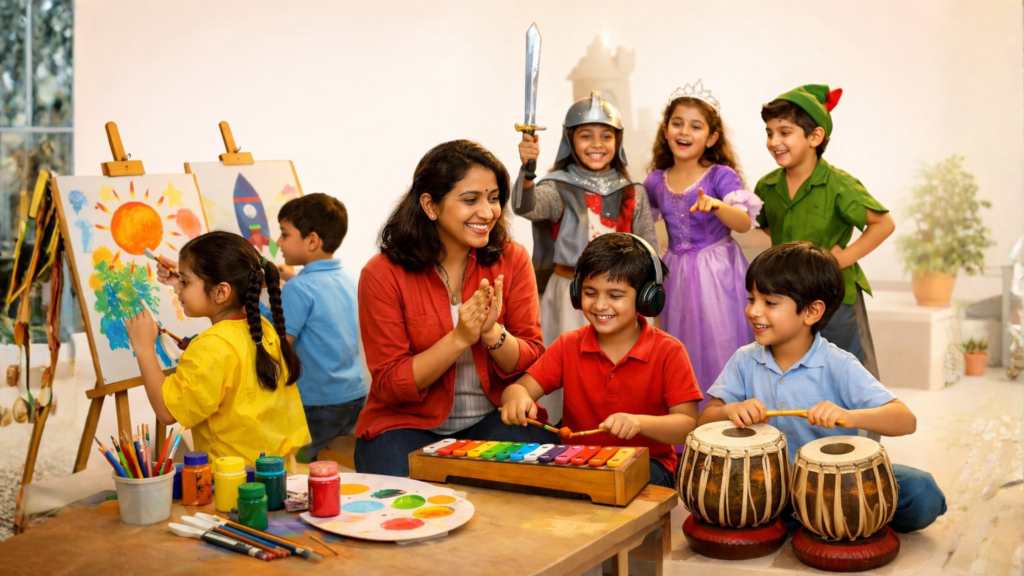
- Foundational stage: language, early numeracy, the world around the child, art, music and physical activity, mostly through play.
- Preparatory stage: languages, mathematics, environmental studies, art and physical education, with more structured lessons.
- Middle stage: languages, mathematics, science, social science, art, physical education and early exposure to skills and vocational work.
- Secondary stage: core subjects in Class 9 and 10 leading to the board examination, then subject choices in Class 11 and 12.
Each stage also builds habits for the next one. Reading for pleasure in the early years supports comprehension in the Middle stage, and project work in Class 6 to 8 prepares students for internal assessment later. Ask schools how they plan that progression across the years, and how they help a child who joins partway through a stage catch up with these habits.
CBSE publishes the detailed curriculum for Classes 9 to 12 each year on its CBSE Academic curriculum page. Schools follow NCERT textbooks for most subjects and add their own activities and projects around them.
How Assessment and Recent Changes Work
CBSE assessment mixes school-based assessment with board examinations. In the early years, teachers assess through observation, activities and portfolios rather than formal exams. From Class 9, students take internal assessments such as projects, practicals and periodic tests, and the Class 10 and Class 12 board examinations follow.
The curriculum is also changing. From the 2026-27 session, CBSE has begun phasing in a three-language framework from Class 6, with at least two Indian languages, and two levels of mathematics and science in Class 9. Changes like these roll out in phases, so ask any school how it is applying them in your child’s class. Our 10 reasons to choose Skalvi explain how we balance this with hands-on learning.
A curriculum on paper is only half the picture. How a school teaches it, how big the classes are and how much time goes to activities shapes what your child actually experiences each day.
Take a simple example from the Preparatory stage. Two CBSE schools may teach the same mathematics chapter on fractions from the same NCERT book. In one, children copy examples from the board and practise sums. In the other, they cut paper strips, share food portions in a role-play and then write the sums. Both follow the curriculum. The second approach usually builds deeper understanding, and children remember it longer. When you visit a school, ask to see one lesson in progress rather than only the timetable.
Class size changes how a curriculum feels too. In a class of 24, a teacher can listen to most children read aloud in a week and spot who needs help with a concept. In a much larger class, the same lesson often becomes more about covering the chapter than checking understanding. Ask schools for their teacher-student ratio at each stage, and whether younger classes have extra adult support.
It also helps to ask how the school links subjects. Projects that bring science, language and art together in one theme are encouraged under the current framework, and they show whether the school is applying the curriculum or only covering it.
What Most People Overlook
We have found that parents compare textbooks but forget to ask how a school assesses young children. In the early years, observation and activity records tell you far more than marks. Customers most often ask us whether CBSE is only about exams. It is not; the current framework puts weight on concepts, skills and activities. Remember that values matter too, which is why our ethics, values and culture sit alongside academics at Skalvi.
How We Help You Understand Our CBSE Programme
Submit an admission enquiry or message our team on WhatsApp to explore our CBSE programme for your child’s grade. We integrate core subjects with Happy Hobby Hours, Integrated Term Projects and hands-on “knowing by doing” activities. Our classrooms use U-shaped seating with a 1:24 teacher-student ratio for Grades 1 to 10.
Verdict
If you want to know what is CBSE curriculum, think of it as four stages, from play-based early years to board examinations, guided by NEP 2020 and updated each year. Ask schools how they teach and assess it, not only what they follow. Visit the Skalvi International School website to explore our CBSE programme.
FAQ
What is CBSE curriculum in simple words?
It is the set of subjects, learning outcomes and assessment rules followed by CBSE-affiliated schools, organised into four stages from pre-school to Class 12.
What is the 5+3+3+4 structure in the CBSE curriculum?
It is the NEP 2020 design that splits schooling into the Foundational, Preparatory, Middle and Secondary stages, covering ages 3 to 18.
Who decides the CBSE curriculum?
CBSE sets the curriculum in line with national policy and the National Curriculum Framework. It publishes the detailed curriculum for the senior classes each year.
Does the CBSE curriculum use NCERT textbooks?
Yes, for most subjects. Schools follow NCERT textbooks and may add their own activities, projects and supplementary material around them.
Are there exams in the early CBSE classes?
In the foundational years, assessment is mostly through observation, activities and portfolios. Formal tests become more common in the later primary and middle years.
When do CBSE board examinations take place?
Board examinations are held at the end of Class 10 and Class 12. Earlier classes are assessed by the school itself.
How many languages do CBSE students study?
From the 2026-27 session, CBSE is phasing in a three-language framework from Class 6, with at least two of the three being Indian languages.
What changed in CBSE mathematics and science recently?
CBSE has introduced two levels, standard and advanced, in mathematics and science for Class 9 from the 2026-27 session, rolling out in phases.
Is the CBSE curriculum good for children who may move cities?
Yes. CBSE schools follow a common national curriculum, so children who move between cities usually find the syllabus familiar in the new school.
Does the CBSE curriculum include arts and sports?
Yes. Art, music, physical education and health are part of the curriculum at every stage, alongside academic subjects and skill-based learning.
What is internal assessment in CBSE?
It is school-based assessment through projects, practicals, portfolios and periodic tests. In Class 9 to 12 it adds to the board examination marks.
Is the CBSE curriculum only about exams?
No. The current framework puts weight on concepts, skills and activities, and how a school teaches it matters as much as the syllabus itself.
Where can parents read the official CBSE curriculum?
CBSE publishes the curriculum for Classes 9 to 12 on its CBSE Academic website each year, along with subject-wise syllabus documents.
Can I see a Skalvi class before choosing a CBSE school?
Yes. Contact our admissions team to arrange a campus visit and see how we teach the CBSE curriculum in your child’s stage.
How do I learn more about Skalvi’s CBSE programme?
Submit an admission enquiry online or message our team on WhatsApp, and we will explain our programme for your child’s grade.