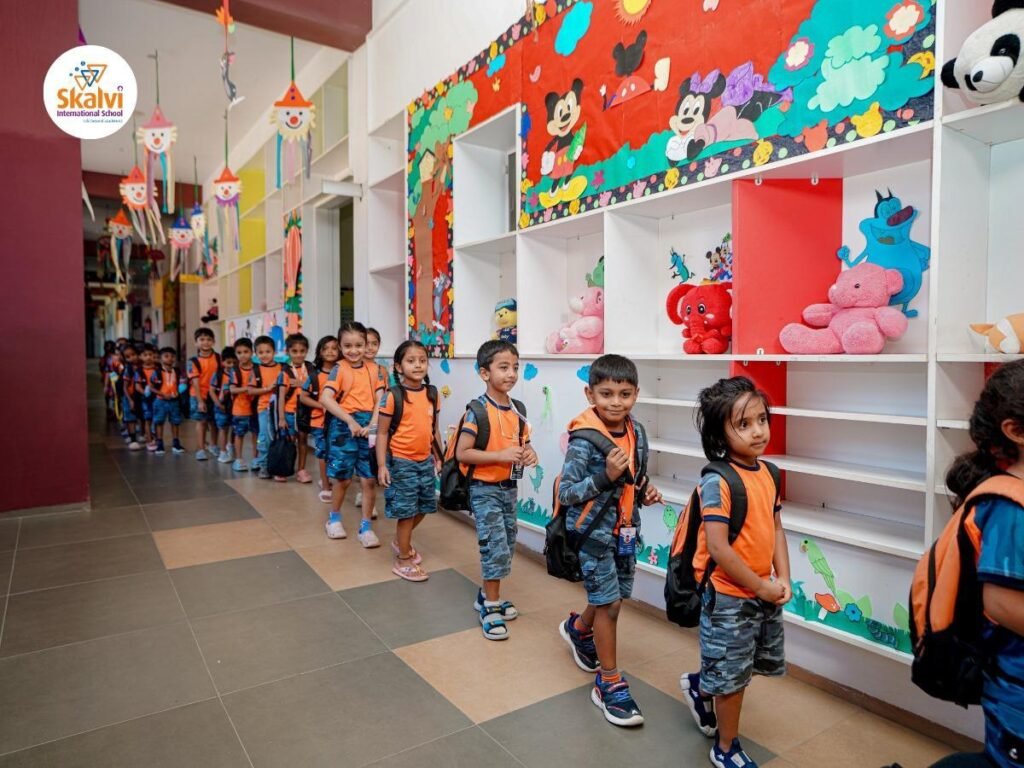
Class 1 is the first formal year of school, and for many families it is also the year they choose a long-term school. A good class 1 admission decision rests on a few clear checks: the age rule, the school’s affiliation, how the early years are taught and what support a child will get. This guide from the Skalvi International School CBSE school in JP Nagar walks you through each check, so you can apply with confidence and avoid last-minute surprises.
What You Will Learn
- The age rule for Class 1 and why it matters
- What to check about a school before applying
- How the Class 1 year should feel for a child
- How to plan your application timeline
Class 1 Admission: The Age Rule and Key Checks
The first thing to confirm is whether your child meets the age rule. According to the Ministry of Education’s reply in the Rajya Sabha, the National Education Policy 2020 sets out a 5+3+3+4 structure in which three years of pre-school cover ages 3 to 6, and Class 1 and Class 2 cover ages 6 to 8. Karnataka requires children to be six years old by 1 June to join Class 1, though the state has given one-year relaxations in recent years. The table lists the main checks.
| Check | What to confirm | Where to look |
|---|---|---|
| Age rule | Child’s age on the cut-off date for the year | Current state order and the school |
| Affiliation | School is CBSE-affiliated and the dates are current | CBSE’s SARAS portal |
| Early-years approach | How Class 1 is taught and assessed | Campus visit and class observation |
| Class size and support | Teacher-student ratio and extra adult help | Admissions team |
| Fees and safety | Fee structure and safety certificates | Mandatory public disclosure page |
Our affiliation details, fee structure and safety certificates are on our mandatory public disclosure page. Age rules can change from year to year, so confirm the current position with our team for 2027-28.
CBSE Class 1 Admission: What to Look for in the School
Once the age is confirmed, look closely at how the school teaches young children. Class 1 sits inside the Foundational Stage, so learning should still be playful, active and hands-on, not a sudden jump into long hours of desk work.
- Teaching style: look for stories, games, songs, movement and hands-on materials alongside early reading and number work.
- Class size: smaller classes mean each child gets more attention in this important first year.
- Extra adult support: some schools add a second adult to help children who need a little more time.
- Daily routine: check break times, meals, outdoor play and how long the school day is.
- Communication: ask how often teachers share progress with parents in the first term.
- Continuity: consider whether the school can take your child through the later years without another change.
At Skalvi, the Foundational Years cover Montessori 2, Montessori 3, Grade 1 and Grade 2, and our academics page explains each stage. Primary students also have associate teachers alongside the class teacher.
Class 1 Admission in JP Nagar: Planning Your Timeline
Class 1 seats in popular schools can fill early, so start planning a few months before the academic year. A simple timeline helps.
First, shortlist two or three schools within a comfortable distance of home. A short daily journey matters more for a six-year-old than for an older child. Next, check each school’s affiliation on CBSE’s SARAS portal and read its disclosure page. Then send enquiries and book campus visits, ideally with your child, so you can see how the school welcomes young children.
It also helps to think about the years after Class 1. A school that can take your child through the primary and middle years avoids another change later, when friendships and routines matter more. Ask each school which grades it offers and how children move from one stage to the next. Look at the daily timetable for Class 1 too. A balanced day with time for play, art, music and outdoor activity alongside reading and maths keeps six-year-olds fresh and engaged.
Keep your documents ready: the birth certificate, address proof, photographs and the pre-school’s progress record if there is one. When a seat is offered, read the fee structure and refund rules carefully before you pay.
Here is a short example. A family in JP Nagar 8th Phase starts in November for a June start. They check the age rule in December, visit three schools in January and confirm a seat in February. By March, uniforms and books are sorted, and the summer is free for gentle preparation at home rather than a last-minute rush.
Our 10 reasons to choose Skalvi include a 1:24 teacher-student ratio for Grades 1 to 10, U-shaped seating with no back benchers and Happy Hobby Hours.
What Most People Overlook
We have found that parents compare academics closely but forget to check the age rule for the exact year their child will join. A few weeks can change which class applies. Customers most often ask us whether their child must read fluently before Class 1. No; curiosity, independence and comfort in a group matter far more at this stage. Remember to confirm the cut-off date in writing before you plan, and to recheck it when the new order for the year is issued.
How We Help You With Class 1 Admission
Submit an admission enquiry or message our team on WhatsApp to enquire about Class 1 admission for 2027-28. Our team can confirm the current age criteria, share the document list and help you book a campus tour on a date that suits your family. You can also ask us about our Foundational Years and how they lead into Grade 1.
Verdict
A sound class 1 admission decision starts with the age rule, then checks affiliation, early-years teaching, class size and fees. Plan a few months ahead and visit with your child. Visit the Skalvi International School website to enquire about Class 1 admission for your child.
FAQ
What should parents check before Class 1 admission?
Check the age rule for the year, the school’s CBSE affiliation, how early years are taught, class size, support, fees and the school’s safety certificates.
What is the minimum age for Class 1 in Karnataka?
Karnataka requires a child to be six years old by 1 June to join Class 1, though the state has given one-year relaxations in recent years.
Does NEP 2020 set an age for Class 1?
NEP 2020 places three years of pre-school at ages 3 to 6, and Class 1 and Class 2 at ages 6 to 8, within the 5+3+3+4 structure.
When should parents start the Class 1 admission process?
Start a few months before the academic year. Many schools take enquiries well in advance, and popular Class 1 seats can fill early.
Which documents are needed for Class 1 admission?
Schools usually ask for a birth certificate, address proof, photographs and, if available, a pre-school progress record. Some may ask for medical details.
Is there an entrance test for Class 1?
No. The RTE Act does not allow screening for elementary admission. Schools may hold a friendly interaction, but it should not decide the seat.
How can parents check a school’s CBSE affiliation?
Search the school’s affiliation number on CBSE’s SARAS portal. The record shows the school’s level, address and current affiliation dates.
Does a child need to read before joining Class 1?
No. Schools build reading during Class 1. Curiosity, listening, independence and comfort in a group matter far more at this stage.
Why does class size matter in Class 1?
Smaller classes let teachers notice each child, support early reading and number work, and help children settle into their first formal year.
How far should a Class 1 school be from home?
A short, manageable journey helps young children arrive rested. Long daily travel can tire a six-year-old and affect their mood and learning.
Should parents visit a school with their child?
Yes, if possible. Your child’s reaction to the classroom and teachers is useful, and the visit makes the first day feel more familiar.
What if my child misses the Class 1 age cut-off?
Check whether the state has announced any relaxation for that year. Otherwise, your child would usually continue in the final pre-school year.
Can a child change schools after Class 1?
Yes, but choosing a school that can take your child through the later years avoids extra adjustments and keeps learning continuous.
Can I visit Skalvi before applying for Class 1?
Yes. Our enquiry form lets you choose a preferred campus tour date, so you and your child can see our Foundational Years classrooms.
How do I enquire about Class 1 admission at Skalvi?
Submit an admission enquiry online or message our team on WhatsApp, and we will confirm the age criteria and next steps for 2027-28.