By encouraging students to explain concepts to their peers, we unlock a higher level of cognitive processing. This article explores how Skalvi integrates the ‘Teach to Learn’ model to enhance involvement, foster critical thinking, and build a foundation for lifelong learning.
Understanding the Protégé Effect in Modern Education
The Protégé Effect is not merely a pedagogical trend; it is rooted in cognitive science. When students expect to teach a subject to others, they study the material more effectively than when they expect only to be tested on it. This preparation phase forces the learner to organize information coherently, identify gaps in their own understanding, and anticipate questions. It shifts the brain from passive reception to active reconstruction.
Within the context of the Skalvi teaching approach, this biological reality is harnessed to maximize retention. Instead of rote memorization, students are encouraged to digest information deeply enough to articulate it to others. This process strengthens neural pathways and ensures that knowledge is not just temporarily stored for an exam, but integrated into the student’s long-term memory.
How the Skalvi Teaching Approach Redefines Classroom Dynamics
Integrating peer instruction requires a shift in the traditional power dynamics of a classroom. It moves the spotlight from the podium to the desk, creating a collaborative ecosystem where every student is both a learner and a mentor.
Moving Beyond Passive Listening
One of the primary goals of interactive classroom methods is to eliminate the ‘zoning out’ phenomenon common in lecture-heavy environments. At Skalvi, the curriculum is designed to be conversational. Students are frequently asked to lead brief sessions or explain a specific problem-solving method to the class. This ensures that student participation improvement is not forced, but is a natural byproduct of the lesson structure. When a child knows they might be called upon to teach, their attention sharpens, and their engagement levels soar.
Creating a Personalized Learning Environment
Every child learns differently, and the ‘Teach to Learn’ model accommodates these variances beautifully. By allowing students to explain concepts in their own words, Skalvi fosters a personalized learning environment. A student who excels visually might explain a concept using diagrams, while a verbal learner might use storytelling. This diversity of expression not only helps the ‘teacher’ consolidate their knowledge but also provides the ‘students’ (their peers) with multiple perspectives on the same topic, increasing the likelihood that the entire class grasps the concept.
The Role of Peer Instruction in Student Engagement at Skalvi
Student engagement at Skalvi is significantly higher than in traditional settings because the stakes are social, not just academic. Peer instruction creates a sense of communal responsibility. When students collaborate, they feel accountable to one another. This social motivation is often more powerful than the desire for a good grade.
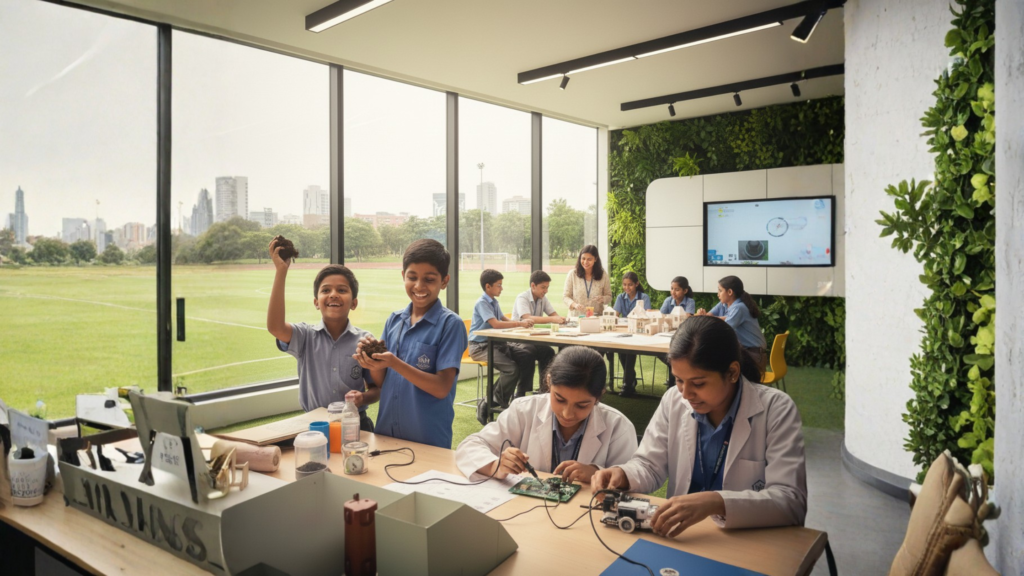
Implementing active learning for children means involving them in the creation of their own education. In a Skalvi classroom, a student isn’t just a vessel to be filled; they are a contributor to the collective intelligence of the group. This approach transforms the classroom from a quiet hall of listeners into a buzzing hub of intellectual exchange. Students ask each other questions, challenge assumptions, and clarify misunderstandings in real-time, often using language and analogies that are more relatable to their age group than what an adult might use.
Building Confidence Through Active Learning
Perhaps the most profound benefit of peer instruction is confidence building in students. Public speaking and the ability to articulate complex ideas are soft skills that are often neglected in standard curricula. However, in the Skalvi model, these skills are practiced daily.
When a student successfully teaches a concept to a peer, they experience a surge of competence. They realize, “I don’t just know this; I own this knowledge.” This validation is crucial for self-esteem. It transforms anxiety into empowerment. Even shy students, when given a safe and structured platform to share their understanding, blossom into articulate communicators. This confidence transcends the classroom, equipping them with the self-assurance needed to tackle challenges in other areas of life.
A Holistic Education Model for the Future
The ultimate goal of education should be to produce well-rounded individuals, not just test-takers. The Skalvi methodology aligns perfectly with a holistic education model. By integrating the ‘Teach to Learn’ strategy, the approach nurtures emotional intelligence (through empathy and patience required to teach others), social skills (through collaboration), and cognitive resilience.
This holistic view ensures that students leave with more than just facts; they leave with the ability to synthesize information, work in teams, and lead with empathy. In a rapidly changing world, the ability to learn, unlearn, and teach others is a future-proof skill set.
Conclusion
The ‘Teach to Learn’ model is more than a technique; it is a philosophy that respects the intelligence and potential of every student. The Skalvi teaching approach exemplifies how modern education can leverage peer instruction to create dynamic, engaging, and effective learning environments.
By prioritizing active learning for children and fostering a personalized learning environment, Skalvi is not just teaching subjects; it is cultivating the next generation of confident, articulate, and collaborative leaders. If you are looking for an educational path that values participation over passivity, it is time to explore what Skalvi has to offer.