The Evolution of Classroom Dynamics
For decades, the standard model of education relied heavily on passive instruction. The teacher stood at the front, and the students listened. However, educational researchers have long recognized that this method often suppresses creativity. At Skalvi School, we have embraced a shift toward student-centered learning. This approach places the learner at the heart of the educational experience, transforming them from passive recipients of information into active creators of knowledge.
When we ask, “How do projects and clubs build innovation?”, the answer lies in the structure of the learning environment itself. By integrating structured projects and dynamic group activities into the daily curriculum, we create a microcosm of the professional world. Students learn to navigate complex problems, not by reading about them, but by solving them.
Core Project-Based Learning Benefits
Project-Based Learning (PBL) is not merely a teaching method; it is a mindset. The project-based learning benefits observed at Skalvi are measurable and profound. Unlike rote memorization, PBL encourages deep understanding and retention.
PBL vs Traditional Education
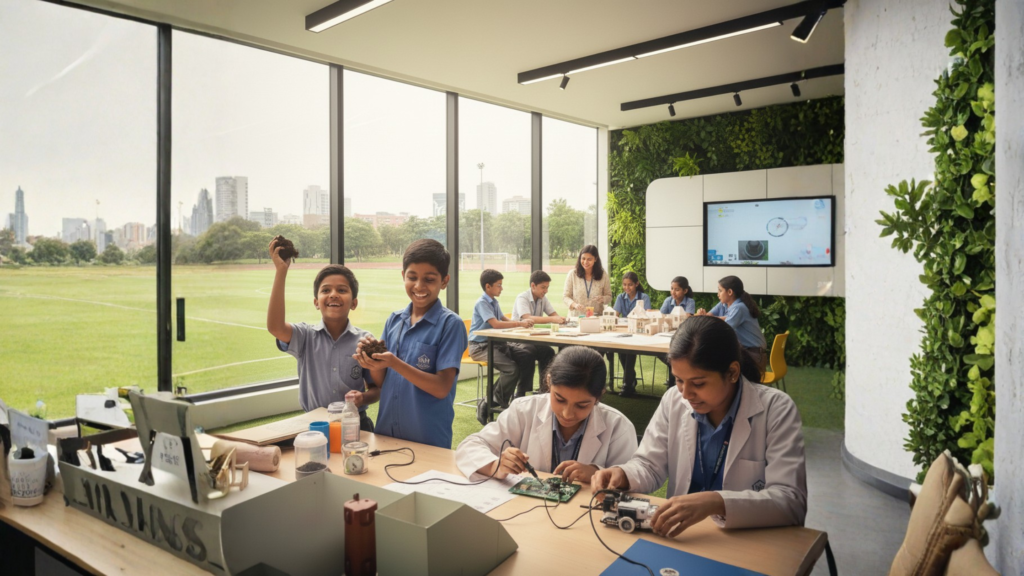
To understand the value of this approach, one must look at the contrast of PBL vs traditional education. In a traditional setting, a student might study physics by reading a chapter on aerodynamics. In a PBL environment at Skalvi, that same student might be tasked with designing a drone prototype to carry a specific payload. The difference is engagement.
- Traditional: Focuses on the “What.” (What is the formula?)
- PBL: Focuses on the “How” and “Why.” (How does this formula apply to my design? Why did the prototype fail?)
This shift leads to higher engagement levels. Students are motivated to learn the underlying theories because they need that knowledge to succeed in their project. This creates a cycle of inquiry where learning is purpose-driven rather than compliance-driven.
Experiential Learning Through Clubs and Activities
Innovation and teamwork are rarely solitary endeavors. They require friction, debate, and collaboration. At Skalvi School, our clubs and group activities serve as laboratories for experiential learning. Whether it is the Robotics Club, the Debate Team, or the Environmental Science Group, these extracurriculars are designed to reinforce the skills learned in the classroom through practical application.
Collaboration in Action
Consider a group project within the Coding Club. Students must work together to build an app. In doing so, they encounter the same challenges faced by software engineers at major tech companies:
- Division of Labor: Recognizing individual strengths and assigning roles.
- Conflict Resolution: Navigating creative differences professionally.
- Iterative Design: Learning that failure is a step toward success.
Through these interactions, students develop emotional intelligence and leadership skills. They learn that the best idea wins, regardless of who proposed it, which is a foundational concept of innovation.
Student-Centered Learning: Empowering Agency
One of the most significant advantages of the Skalvi model is the agency it grants students. Student-centered learning means that students have a voice in their education. When a student chooses a topic for a semester-long project or campaigns for a leadership role in a club, they are practicing autonomy.
This autonomy breeds accountability. When students own their learning journey, they are more resilient in the face of setbacks. They view challenges not as insurmountable obstacles, but as puzzles to be solved. This resilience is a key component of the innovative mindset.
From Theory to Practice: Applied Knowledge
The ultimate goal of education is the transfer of skills. Can a student take what they learned in a history lesson and apply it to a political science project? Can they take a mathematical concept and use it in an art installation? This is applied knowledge.
Projects at Skalvi are interdisciplinary by design. A project on “Sustainable Cities” might require:
- Science: Understanding renewable energy sources.
- Math: Calculating budget constraints and resource allocation.
- English: Writing a persuasive proposal for the city council.
- Art: Creating a 3D model of the city layout.
By forcing these disciplines to converge, we teach students that the world is not segmented into isolated subjects. Innovation happens at the intersection of fields. By fostering this holistic view, Skalvi prepares students to become the visionaries of tomorrow.
Building the Future at Skalvi
The landscape of the future workforce is uncertain, but the skills required to navigate it are clear: adaptability, collaboration, and creative problem-solving. Through our commitment to experiential learning and the tangible project-based learning benefits embedded in our curriculum, Skalvi School is dedicated to molding not just better students, but better citizens and innovators.
Our clubs, projects, and activities are more than just fun additions to the school day—they are the training grounds for the leaders of the future. We invite you to explore how our unique approach can unlock your child’s potential.