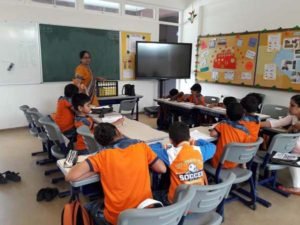
What Makes a School a Strong Choice for Families in Bangalore?
For families planning for the 2027–28 academic year, choosing a school involves more than identifying a well-known institution. Parents need to understand whether the school provides an environment that supports their child’s academic progress, personal development, interests and everyday needs. This makes quality school in Bangalore a useful consideration when building a shortlist.
For families seeking quality education in Bengaluru, institutions such as Skalvi International School can serve as a strong benchmark during this evaluation. Rather than judging a school through one feature, parents can look at several indicators that contribute to a meaningful educational experience.
What Defines a Quality School?
A quality school should provide more than classroom instruction. Parents can consider how different aspects of education work together.
Important areas include:
→ Academic learning
→ Curriculum and accreditation
→ Holistic development
→ Technology-enabled education
→ Safety and security
→ Values and school culture
→ Parent-school communication
→ Infrastructure and resources
→ Student opportunities
→ Long-term educational continuity
The importance of each factor may differ depending on the child and family.
How Important Is Academic Learning?
Academic learning remains a central part of school education. Parents should understand how the school helps students develop conceptual knowledge rather than focusing only on examination outcomes.
They can ask:
→ How are concepts explained?
→ Are students encouraged to ask questions?
→ How is progress monitored?
→ What support is available when students face challenges?
→ Are children encouraged to think independently?
Families can explore Skalvi International School’s Academic Programmes to understand its approach to academic learning.
Why Should Parents Look at Holistic Development?
Children develop through experiences both inside and outside the classroom. A school can support this development by providing opportunities for students to explore different interests.
These may include:
→ Sports
→ Creative arts
→ Projects
→ Team activities
→ Presentations
→ Leadership opportunities
Such activities can help students build confidence, communication, creativity and collaboration.
What Role Does Technology Play?
Technology can support education when it is integrated with a clear learning purpose. Parents should understand how digital resources are used rather than simply checking whether technology is available.
Technology may help with:
→ Interactive lessons
→ Visual explanations
→ Digital resources
→ Research
→ Collaborative learning
Technology should complement teacher guidance and classroom interaction.
Why Is Safety an Important Indicator?
Parents need confidence that their child will learn in a safe and supportive environment. Families can ask about:
→ Campus access
→ Visitor management
→ Student supervision
→ Emergency procedures
→ Activity safety
→ Transportation safety
A campus visit can also help parents observe how the school environment is organised.
How Does School Culture Influence Children?
A child spends a significant part of the day at school, making the culture of the institution important.
Parents can look for an environment that encourages:
→ Respect
→ Responsibility
→ Empathy
→ Integrity
→ Cooperation
→ Cultural awareness
Teacher-student interactions can provide useful insight into how these values are reflected in everyday school life.
Why Does Parent-School Communication Matter?
Education becomes more connected when parents and teachers communicate clearly about a child’s progress and development.
Parents should understand how the school shares:
→ Academic updates
→ Important announcements
→ Student activities
→ Events
→ Areas requiring additional support
Students should also have appropriate opportunities to approach teachers when they need guidance.
Families can explore Skalvi’s broader educational approach while considering different aspects of the school environment.
What Should Parents Look for in Infrastructure?
Infrastructure should be assessed according to its educational usefulness rather than appearance alone.
Parents can review:
→ Classrooms
→ Library
→ Laboratories
→ Activity spaces
→ Sports facilities
→ Technology resources
The key question is whether students have meaningful access to these facilities as part of their learning.
Do Student Opportunities Matter?
Parents can ask about opportunities for students to participate in academic and non-academic activities.
These may include:
→ Competitions
→ Sports
→ Arts
→ Projects
→ Cultural activities
→ Leadership
The goal is to understand whether children are encouraged to explore their interests and develop their abilities.
Should Families Consider Long-Term Continuity?
Parents may also consider whether a school can support their child across multiple academic stages.
Useful questions include:
→ Which grades are offered?
→ How does the learning approach develop as students progress?
→ What resources are available for older students?
→ How are students supported as academic expectations increase?
Long-term planning can help families consider more than the immediate admission year.
Why Does the Daily Commute Matter?
Bangalore’s traffic can make travel time an important practical consideration. Parents should assess the actual journey during school hours.
Consider:
→ Travel time
→ Traffic conditions
→ Transportation availability
→ Pickup and drop arrangements
→ Effect on sleep and homework
→ Time available for activities
A manageable commute can contribute to a more balanced daily routine.
How Can Parents Evaluate a School During a Visit?
A campus visit allows parents to see aspects of school life that may not be obvious online.
Families can observe:
→ Classroom interaction
→ Teacher-student communication
→ Student participation
→ Learning spaces
→ Safety arrangements
→ General campus atmosphere
Parents should also allow their child to share their impressions after the visit.
How Can Families Build a Shortlist?
Parents can evaluate schools using the same criteria rather than changing their priorities for each institution.
A practical checklist can include:
→ Academic approach
→ Curriculum
→ Holistic development
→ Technology
→ Safety
→ Values
→ Communication
→ Infrastructure
→ Student opportunities
→ Commute
→ Long-term continuity
This makes the decision-making process more structured.
What Should Parents Avoid?
Families should avoid selecting a school solely because of:
→ Popularity
→ Rankings
→ Advertising
→ One facility
→ One achievement
→ Online reviews
These can provide useful information, but they do not represent the entire educational experience.
Conclusion
Identifying a quality school in Bangalore requires parents to consider the complete educational environment. Academics, curriculum, holistic development, technology, safety, values, communication, infrastructure, student opportunities and practical factors can all contribute to a child’s school experience.
For families seeking quality education in Bengaluru, institutions such as Skalvi International School can serve as a strong benchmark during this evaluation. Parents planning for 2027–28 can combine online research, official information and campus visits to identify an environment that fits their child’s individual needs.
Frequently Asked Questions
1. What makes a quality school in Bangalore?
A quality school can combine strong academics, student development, safety, values, resources and supportive communication.
2. Should academic results be the only consideration?
No. Parents should also consider how students learn and develop beyond examination performance.
3. Why is holistic development important?
It provides opportunities for children to develop physical, creative, social and communication skills.
4. How should parents evaluate school infrastructure?
They should consider whether classrooms, laboratories, libraries and other facilities meaningfully support student learning.
5. Why should parents visit the campus?
A campus visit helps families observe the learning environment, student interaction and overall school atmosphere.
6. What should parents ask about safety?
They can ask about campus access, supervision, visitor management, emergency procedures and transportation.
7. Why does school culture matter?
A positive culture can support respect, responsibility, cooperation and confidence.
8. How does technology support education?
Technology can provide interactive lessons and additional resources when used purposefully.
9. Should parents consider long-term schooling?
Yes. Families can consider whether the school supports their child across multiple academic stages.
10. How can parents shortlist schools?
Families can compare schools using consistent criteria covering academics, development, safety, resources, values and practical needs.