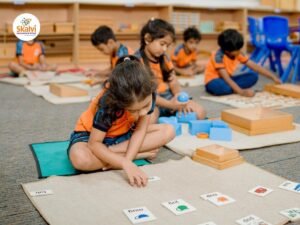
When a school meets a three-, four- or five-year-old for the first time, parents often worry that their child is being tested. In practice, an interaction with students of this age should look nothing like an exam. This guide from the Skalvi International School CBSE school in JP Nagar explains how young children are assessed today, what a child admission assessment should and should not include, and how parents can help their child feel at ease.
What You Will Learn
- How early-years assessment works under current frameworks
- What a good interaction with a young child looks like
- What schools should not ask of young children
- How parents can help their child feel at ease
Interaction With Students: How Young Children Are Assessed
For children aged 3 to 8, India’s curriculum framework treats assessment very differently from exams. According to PARAKH at NCERT, assessment at the Foundational Stage helps teachers understand how children learn, grow and develop, and it should emerge through play, storytelling, exploration, songs and movement. The table compares good practice with what to avoid.
| Good practice | Avoid |
|---|---|
| Play with blocks, books or puzzles | Written tests or worksheets |
| A relaxed chat about favourite things | Rapid-fire questions to recite |
| Observing how the child settles and engages | Scoring or ranking children |
| A parent nearby if the child needs it | Separating an anxious child too quickly |
| Notes used to plan support | Results used to decide the seat |
For admission to elementary classes, the RTE Act also prohibits screening that picks one child over another. You can see how our early years are organised on our academic programmes page, from Bal Kendra and Bal Vatika to the Foundational Years.
Child Admission Assessment: What a Good Interaction Looks Like
A good interaction with a young child is short, playful and led by an experienced early-years teacher. The aim is to learn about the child, not to grade them.
- Settling: the teacher notices how the child separates from parents and responds to a new place.
- Communication: a simple chat shows how the child speaks, listens and expresses needs, in any language they are comfortable with.
- Play and movement: building, drawing or a simple game shows interests, attention and coordination.
- Social cues: the teacher observes how the child responds to adults and to other children, if any are present.
- Support needs: anything the teacher notices helps the school plan for the child’s first weeks.
Here is an example. A four-year-old hides behind her mother when she enters the room. The teacher does not push. She opens a picture book nearby and starts reading aloud. After a few minutes, the child comes closer and points at an animal. The teacher has learned that the child is cautious with new people but curious and engaged once she feels safe, which is exactly the kind of insight that helps her settle later.
What Schools Should Not Ask of Young Children
Young children develop at very different rates, and a few months can make a big difference at this age. That is why recitation of alphabets, numbers or rhymes, written work or general-knowledge questions are not good ways to judge a three- or four-year-old.
Schools should also avoid making the child feel they have passed or failed. A child who is quiet, tired or shy on the day has not done badly. If something worries a parent, such as a school asking for written work from a toddler, it is reasonable to ask the school how it uses the activity.
Parents can help a lot with the visit itself. Choose a time when your child is usually rested and fed. Explain the visit simply: “We are going to see a school and maybe play with a teacher.” Avoid practising answers. After the visit, ask your child what they liked, and listen to what they say without correcting or adding to it.
Siblings and comparisons are worth a thought as well. Parents sometimes compare a younger child with an older sibling who was more talkative or confident at the same age. Teachers try not to make such comparisons, and parents can help by not mentioning them in front of the child. Each child’s first visit is their own.
After the interaction, it is fine to ask the teacher what they noticed. A good early-years teacher will share a few warm, specific observations, such as how your child enjoyed the blocks or listened to the story, along with anything the school will plan for. Those notes help both home and school support the child in the same way from the very first week.
A school’s overall approach to childhood matters here too. Our about us page explains our child-centric philosophy, and our 10 reasons to choose Skalvi include a 1:15 teacher-student ratio for Montessori classes.
What Most People Overlook
We have found that parents worry about what their child will “get right” in the meeting, when teachers are really looking at how the child plays and settles. Customers most often ask us whether their child should know letters and numbers before joining. At this age, curiosity and comfort matter far more. Remember to share any concerns, such as speech or sensory needs, so the school can plan well. Sharing early is a sign of partnership, not a risk to your child’s place, and it helps teachers welcome your child in the way that suits them best.
How We Help You Understand Our Approach
Submit an admission enquiry or message our team on WhatsApp to understand our approach to meeting young children. Our team can explain what a visit involves for your child’s age, and you can choose a preferred campus tour date in our enquiry form.
Verdict
An interaction with students in the early years should feel like play, not a test. Teachers observe how a child settles, communicates and engages, and use what they see to plan support. Visit the Skalvi International School website to understand our approach to meeting young children.
FAQ
What is an interaction with students at admission?
It is a short, informal meeting where a teacher spends time with the child through play or conversation, to get to know them and plan support.
How are children aged 3 to 8 assessed?
Under the Foundational Stage framework, assessment happens through observation, play, stories and children’s work, not through written tests or exams.
Do young children need to know letters before admission?
No. At this age, curiosity, communication and comfort in a new place matter more than knowing letters or numbers in advance.
Can schools give written tests to nursery children?
Written tests are not appropriate for young children. Early-years frameworks favour observation and play, and the RTE Act prohibits screening for elementary admission.
What does a teacher look for in a young child’s interaction?
Teachers usually notice how the child settles, communicates, plays and responds to adults, so they can plan the right support.
What if my child cries during the interaction?
That is common at this age. Experienced teachers expect it and give the child time to settle. It should not count against your child.
Should a parent stay with the child during the interaction?
Many schools let a parent stay nearby, especially for very young or anxious children. Ask the school what it prefers.
How should I prepare my young child for a school visit?
Keep it simple. Explain that you are visiting a school and may play with a teacher, and choose a time when your child is rested.
Can a child speak the family’s home language in the interaction?
Usually yes. Teachers want to understand how a child communicates, so it helps to let them use the language they are most comfortable with.
Is a child’s age important for early-years admission?
Yes. Each class has age criteria, so check your child’s date of birth against the school’s criteria for the grade you are applying for.
Should parents share developmental concerns with the school?
Yes. Sharing concerns such as speech or sensory needs early helps the school plan the right support for your child.
Does a quiet child do badly in an interaction?
No. Many young children are quiet with new adults. A good school sees this as normal and gives the child time to settle.
How long is an interaction with a young child?
It is usually short, because young children engage best in brief, relaxed sessions. Ask the school roughly how long it lasts so you can plan the visit.
Can my child visit the Skalvi Montessori classrooms first?
Yes. Choose a preferred campus tour date on our enquiry form, and your child can see the early-years classrooms in a relaxed way.
How do I learn about Skalvi’s approach for young children?
Submit an admission enquiry online or message our team on WhatsApp, and we will explain how we meet and welcome young children.