In the dynamic landscape of the 21st century, rote learning is rapidly becoming obsolete. The modern world doesn’t just demand knowledge; it demands the ability to apply that knowledge, to question, to innovate, and to create. This unique blend of skills, critical thinking, creativity, and problem-solving is what we term ‘Inventiveness.’ For students enrolled in CBSE schools in Bangalore, or any educational institution aiming for true global relevance, cultivating this inventiveness is paramount. It’s the key to transforming learners into leaders, and consumers of information into creators of solutions.
Schools are now tasked with shifting their focus from mere curriculum coverage to genuine skill development. Institutions like the Global Indian International School recognize this profound shift, embedding inventiveness into the very fabric of their pedagogy to prepare students for a future defined by rapid change and complex challenges.
The Pillars of Inventiveness: Critical Thinking and Creativity
Inventiveness is not a singular skill but the synergistic output of two core competencies:
- Critical Thinking: This is the ability to analyze information objectively and make a reasoned judgment. It involves questioning assumptions, evaluating evidence, discerning fact from opinion, and constructing logical arguments. It’s the analysis engine.
- Creativity: This is the ability to generate new and original ideas, solutions, and possibilities. It involves divergent thinking, imagination, and the courage to explore unconventional paths. It’s the generation engine.
When students learn to critically evaluate a problem (Critical Thinking) and then use that evaluation to spark novel solutions (Creativity), they achieve Inventiveness—the ultimate skill for tackling real-world complexity.
Pedagogical Strategies for Nurturing Inventiveness
A classroom dedicated to inventiveness looks fundamentally different from a traditional one. It is a vibrant, safe space where inquiry is celebrated and mistakes are viewed as essential data points for learning.
1. Embracing Project-Based Learning (PBL)
Project-Based Learning is arguably the most effective vehicle for inventiveness. Instead of studying concepts in isolation, students work on complex, engaging, and authentic problems or challenges over an extended period.
- Real-World Context: PBL moves beyond theoretical questions. For instance, instead of simply studying ‘renewable energy’ in science, students are tasked with designing and prototyping a sustainable power solution for a section of their school campus.
- Holistic Skill Application: This forces students to use interdisciplinary skills—mathematical modeling, scientific inquiry, persuasive writing for the proposal, and aesthetic design—mirroring the collaborative demands of a modern workplace.
- Encouraging Trial and Error: When students prototype an idea, they inevitably face setbacks. This process naturally builds resilience and shifts the focus from achieving a perfect ‘product’ to refining the ‘process,’ which is a cornerstone of inventiveness.
2. Inquiry-Based Learning and the Culture of Questioning
The simple act of asking “Why?” or “What if?” is the ignition switch for critical thinking. Schools must actively foster a culture where student questions are more valued than student answers.
- Socratic Seminars: Teachers can use open-ended discussions, often called Socratic Seminars, to challenge assumptions and explore different perspectives on complex topics in history, literature, or current events. This teaches students to articulate and defend their viewpoints logically.
- “Deconstruct and Reconstruct” Activities: Students can be given an existing system or product (like a phone app, a historical treaty, or a social policy) and asked to:
- Deconstruct: Critically analyze its flaws and unintended consequences.
- Reconstruct: Invent a significantly improved version.
- Technology as a Tool for Discovery: Integrating digital tools and virtual labs allows students to test hypotheses and conduct independent research, transforming them from passive consumers of information into active investigators.
3. Integrating STEAM and Arts Education
Creativity is often erroneously confined to the arts, but its principles are vital in STEM fields. The Global Indian International School champions a STEAM (Science, Technology, Engineering, Arts, and Mathematics) approach, which is crucial for inventiveness.
- Arts for Divergent Thinking: Visual arts, music, drama, and creative writing encourage students to express themselves uniquely, experiment with form, and think divergently. This fosters the imaginative leap required for truly novel solutions.
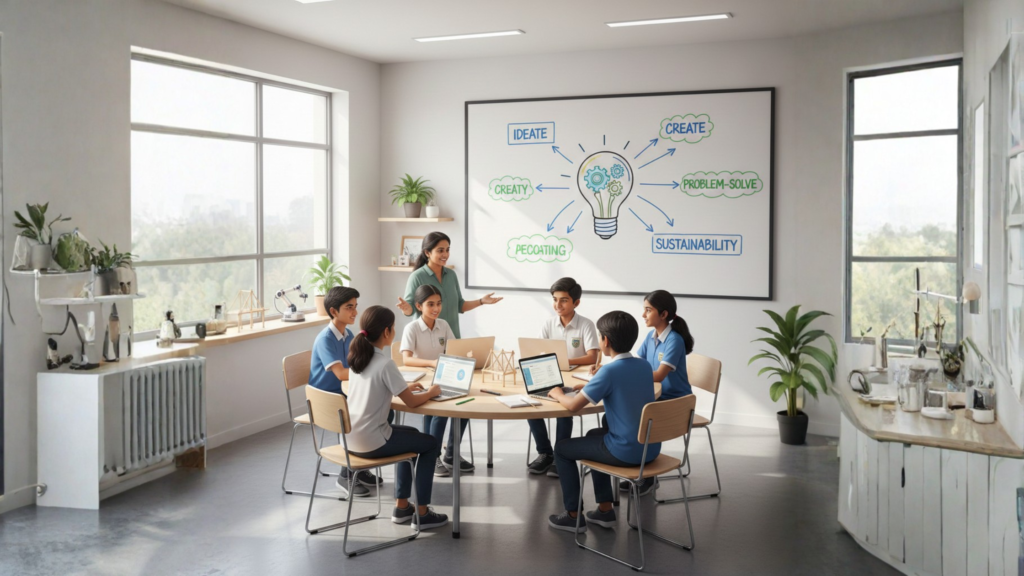
- Design Thinking Workshops: Design Thinking is a non-linear, problem-solving methodology that starts with empathy (understanding the user’s needs) and cycles through ideation, prototyping, and testing. Implementing dedicated design thinking workshops, where students use sticky notes, brainstorming, and rapid prototyping, provides a structured framework for applied creativity and inventive problem-solving.
4. Cultivating a Growth Mindset and Emotional Intelligence
Inventiveness requires the psychological safety to fail. A student operating with a fixed mindset (“I’m just not creative”) will never take the intellectual risks necessary for innovation.
- Embracing Failure: Educators must normalize errors, reframing them as “learning opportunities” or “first attempts in learning” (FAIL). This reduces the fear of judgment and encourages more audacious experimentation.
- Reflective Practices: Encouraging students to maintain a “Find Journal” or a process diary helps them reflect on how they arrived at a solution, not just what the final solution was. This practice deepens self-awareness and emotional intelligence, making their thinking process visible and trainable.
- Collaboration Over Competition: Fostering collaborative learning environments where groups of students work together to solve challenges exposes them to diverse viewpoints. The clash of different ideas, when managed respectfully, is a powerful catalyst for collective inventiveness. This is particularly important for students in competitive CBSE schools in Bangalore who need to balance academic rigor with teamwork skills.
The Role of Educators and Infrastructure
The most inventive curriculum is only as good as the hands that deliver it. Teachers must transition from being knowledge-dispensers to being mentors, facilitators, and chief instigators of curiosity.
- Professional Development: Regular training for teachers in innovative pedagogies like PBL, Design Thinking, and Socratic questioning is essential.
- Creating ‘Creation Labs’: Schools should invest in dedicated physical spaces like robotics labs, tinkering studios, and maker spaces—often seen in forward-thinking institutions like the Global Indian International School, where students can physically build, code, design, and test their inventive ideas outside the confines of a traditional classroom.
Cultivating inventiveness is not an educational trend; it is an economic and social imperative. By strategically merging critical thinking with creativity through experiential, interdisciplinary, and inquiry-driven methods, CBSE schools in Bangalore and across the country can empower the next generation. The future belongs to the students who can look at a problem, analyze its dimensions, and invent a solution the world hasn’t seen before. The journey to inventiveness begins in the classroom, fueled by curiosity and guided by the courage to create.