In a world that is evolving at a breakneck speed, simply memorizing facts from a textbook is no longer sufficient to equip your child for future success. The modern educational landscape demands critical thinkers, creative problem-solvers, and adaptable individuals. This is the core philosophy behind Experiential Learning, an educational approach that emphasizes learning through direct experience, hands-on activities, and reflection. It’s the vital difference between knowing a concept and truly understanding it, between merely passing an exam and possessing the skills to thrive in life. For parents seeking the most comprehensive and future-proof education for their children, this shift is paramount. It is why leading international schools in Bangalore are moving away from traditional models and embracing this dynamic, immersive pedagogical method.
This comprehensive guide will delve deep into the essence of experiential learning, its unparalleled benefits, and how you can find institutions in the city that truly champion this approach, including the best international schools in Bangalore and top boarding schools in Banglore.
The Experiential Learning Model: From Theory to Practice
Experiential learning is rooted in the work of educational theorist David Kolb, who defined it as a cyclical process:
- Concrete Experience: The student engages in an activity or experience (e.g., conducting a science experiment, managing a simulated business, or participating in a community service project).
- Reflective Observation: The student reflects on the experience, discussing what happened, what worked, and what didn’t.
- Abstract Conceptualization: The student draws conclusions and develops a general theory or new understanding from the reflection.
- Active Experimentation: The student plans how to use this new understanding in future situations or experiments.
Unlike rote learning, this cycle ensures that knowledge is not just temporarily stored but deeply integrated. It moves the learning process from the passive reception of information to the active construction of meaning, making it incredibly relevant and impactful.
Why Experiential Learning is Crucial for 21st-Century Skills
The benefits of this ‘learning by doing’ approach go far beyond academic grades. They cultivate the essential character traits and practical skills that employers, universities, and life itself demand.
1. Fostering True Understanding and Retention
When a student learns about supply and demand by running a school market stall, or learns about physics by designing a working model, the theoretical concepts become tangible realities. This real-world connection significantly boosts information retention and makes the subject matter more meaningful. The best CBSE international schools in Bangalore that integrate this hands-on learning into their curriculum report higher levels of engagement and deeper conceptual clarity, even in traditionally theoretical subjects. Students are encouraged to not just ask ‘what,’ but ‘why’ and ‘how.’
2. Cultivating Critical Thinking and Problem-Solving
Experiential activities are, by nature, messy and open-ended. A robotics challenge doesn’t come with an answer key; a drama production presents logistical and creative hurdles. This forces children to think on their feet, analyze complex situations, devise strategies, and troubleshoot failures—the very essence of problem-solving. This shift from prescribed learning to innovative thinking is arguably the most valuable asset a modern student can possess.
3. Enhancing Motivation and Student Agency
Engagement is the silent killer of learning. Students often check out when material feels irrelevant. Experiential learning, however, inherently increases intrinsic motivation because it situates learning in real-life contexts that are immediately relevant. When students are given agency—the power to make choices and take ownership of their projects—their engagement soars. Schools in Bangalore that prioritize outbound learning programs, industry visits, and community service projects are seeing students who are not just attendees, but active participants and leaders in their own education.
4. Building Essential Soft Skills: Teamwork and Leadership
Many experiential projects—from group-based lab experiments to collaborative theatre performances—require teamwork. Students learn to negotiate, delegate, communicate effectively, and manage conflict. For students in boarding schools in Banglore, where communal living is part of the daily routine, these activities are doubly effective. They not only develop academic skills but also the vital interpersonal relationships and leadership qualities necessary for success in diverse, global environments.
5. Promoting Holistic Development and Wellbeing
Experiential learning often incorporates multi-sensory and kinaesthetic experiences, which are shown to positively impact a student’s wellbeing, boosting confidence and emotional regulation. Whether through a field trip to a botanical garden, a sustainability project, or an overnight camp, students gain an improved sense of community and empathy. This holistic approach is a trademark of the best international schools in Bangalore, which aim to nurture the whole child, not just the intellect.
Experiential Learning in the Silicon Valley of India: Finding the Right School
Bangalore, as a hub of innovation and global culture, is home to a multitude of excellent educational institutions. But how can parents discern which international schools in Bangalore truly embed experiential learning into their ethos?
1. International Schools: A Global Focus on Experience
Many international schools in Bangalore that offer curricula like the IB (International Baccalaureate) or IGCSE/A-Levels are structurally aligned with experiential learning. These curricula are inquiry-based, emphasizing projects, research, and real-world application.
- Look for Project-Based Learning (PBL): Do school projects involve open-ended challenges, collaboration, and a public presentation of the final work? PBL is a key indicator of experiential teaching.
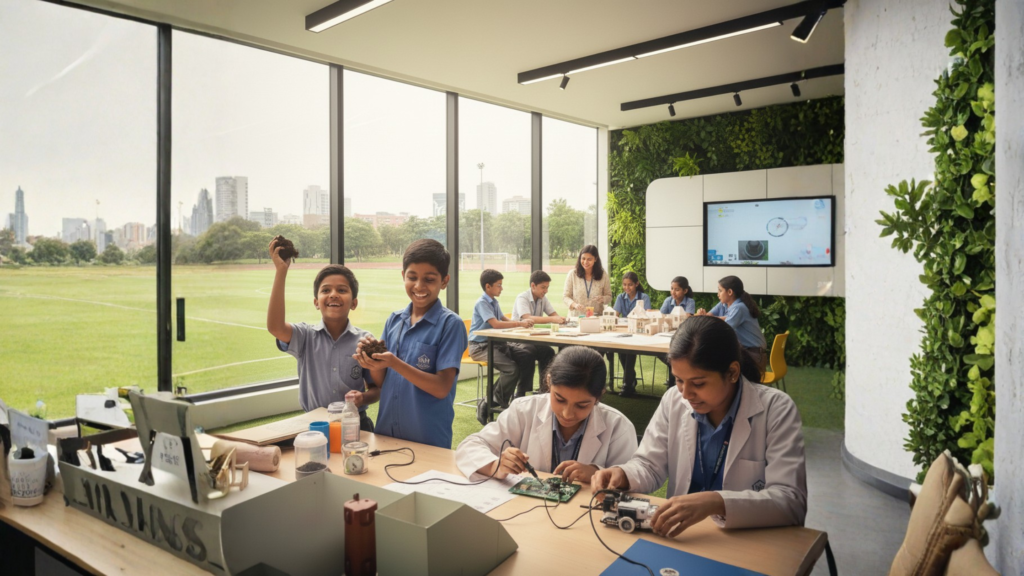
- Check for Labs, Studios, and Makerspaces: The availability and active use of dedicated robotics labs, STEM facilities, art studios, and collaborative learning spaces show a commitment to hands-on learning. Schools in Bangalore with state-of-the-art facilities explicitly designed for ‘doing’ are excellent choices.
- Evaluate Outbound and Fieldwork Programs: Regular, meaningful field trips (not just casual sightseeing), industry visits, and outbound leadership camps demonstrate a dedication to connecting classroom theory with the world outside.
2. The CBSE Advantage: Best CBSE International Schools in Bangalore
For parents who prefer the familiarity and structure of the national curriculum, many of the best CBSE international schools in Bangalore have successfully adopted an experiential approach, aligning with the principles of the New Education Policy (NEP) 2020. These schools often combine the academic rigour of the CBSE board with:
- Integrated STEM/STEAM: Hands-on science experiments, mathematics simulations, and design thinking projects replace simple textbook exercises.
- Financial Literacy Simulations: Practical exercises in budgeting and investment teach students the real-world application of mathematics.
- Art and Drama Integration: Role-playing historical events or literary scenes, and participating in public speaking and debates, bring language and social studies to life.
3. Boarding Schools in Banglore: A 24/7 Immersion
Boarding schools in Banglore offer a unique environment for experiential learning, as the learning process is not confined to school hours. The residential setting provides ample opportunities for sustained, long-term, and immersive experiences that build character and independence:
- Structured Co-Curricular Programs: From farming and sustainable living projects to intensive sports and arts programs, the extended day allows for deep dives into co-curricular activities, which are inherently experiential.
- Life Skills and Self-Management: Living away from home teaches invaluable lessons in personal care, time management, problem-solving, and community living—all powerful, direct experiences that shape responsible global citizens.
- Leadership and Mentorship: Boarding life often involves senior students mentoring juniors, organizing house events, and holding leadership roles, providing practical, real-time leadership experience.
Success Stories: The Transformative Power
The success stories emerging from schools that champion experiential learning are compelling. Instead of just producing students with high test scores, these institutions are nurturing young “life entrepreneurs”—individuals who can take initiative, create solutions, and lead with purpose.
Consider a student who led a ‘Waste-to-Wealth’ project, turning campus organic waste into compost, which was then used in the school garden. This single experience taught them practical science (decomposition), economics (resource management), teamwork, and social responsibility far more effectively than any textbook chapter. They didn’t just learn about the concept; they experienced its impact, failures, and ultimate success. This is the difference between an informed graduate and an innovative, world-ready changemaker.
Conclusion: The Future is Hands-On
As parents, the choice of education is the single most important decision we make for our children’s future. The rapidly changing global economy requires a skillset that is flexible, practical, and deeply rooted in real-world understanding. Experiential learning is not a fad; it is the fundamental shift necessary to future-proof your child’s success.
When evaluating the many excellent international schools in Bangalore, look beyond the glossy brochures and academic results. Look for evidence of the experiential cycle in action: hands-on labs, challenging projects, community engagement, and a culture of reflection and innovation. Whether you choose one of the best international schools in Bangalore, a dedicated boarding school in Banglore, or a progressive institution among the best CBSE international schools in Bangalore, ensure their core philosophy is learning by doing. By choosing an experiential education, you are not just investing in your child’s report card; you are investing in their confidence, their capability, and their future as successful, engaged global citizens.