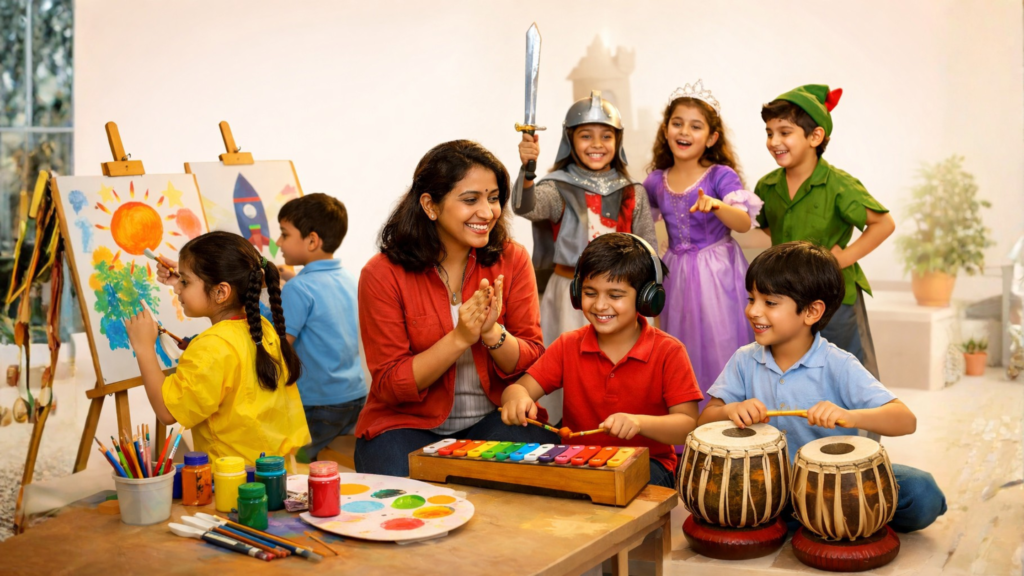
In an increasingly competitive global landscape, the education system often places a heavy emphasis on STEM subjects—Science, Technology, Engineering, and Mathematics. While these areas are undoubtedly critical for a modern workforce, a truly holistic education must encompass the development of the whole child: intellectually, socially, emotionally, and creatively. This is where the Power of Play, the strategic and deep integration of Art, Music, and Theatre into the core curriculum—becomes not just a desirable add-on, but an essential component of 21st-century schooling.
Leading institutions, particularly forward-thinking schools like the Global Indian International School (GIIS), have long championed this integrated approach, recognizing that the arts are the wellspring of innovation, critical thinking, and empathy. For parents evaluating educational choices, especially within the array of boarding schools in Bangalore, an institution’s commitment to the performing and visual arts is a clear indicator of its dedication to producing well-rounded, future-ready global citizens.
Why Arts Integration is Crucial for Cognitive Development?
The myth that the arts are simply a ‘break’ from ‘real’ learning is long past. Modern cognitive science demonstrates that engaging in creative activities actively enhances the brain’s capacity for traditional academic subjects.
- Enhanced Cognitive Skills: When a student composes a piece of music or designs a set for a play, they are simultaneously engaging in complex mathematical and spatial reasoning. In fact, research shows a correlation between drama participation and higher scores in verbal and math components of standardized tests. Integrating drama to act out historical events, for example, transforms passive absorption of facts into a visceral, memorable, and multidimensional learning experience.
- Creative Problem-Solving: The arts teach students to embrace ambiguity and explore multiple solutions. A painter dealing with perspective, a musician improvising, or an actor interpreting a complex character are all honing their creative problem-solving skills. They learn to think “outside the box”—a crucial skill highly sought after by employers today. This is the bedrock of innovation that schools like Global Indian International School foster through their well-defined educational frameworks.
- Improved Memory and Retention: Learning through multiple modalities—visual (Art), aural (Music), and kinesthetic (Theatre)—significantly boosts memory. Singing the periodic table or staging a scene from a classic novel embeds the content far deeper than rote memorization ever could.
Cultivating Essential 21st-Century Skills through Play
The benefits of the arts extend far beyond the individual’s cognitive development. They are perhaps the most powerful tool for cultivating the social and emotional intelligence required to thrive in a collaborative, multicultural world.
Communication and Collaboration
Theatre, in particular, is the ultimate masterclass in teamwork. Every production, from a small classroom skit to a full-scale musical, requires students to work together, communicate effectively, and rely on one another.
- Verbal and Non-Verbal Fluency: Students learn to project their voices, interpret body language, and communicate complex emotions and ideas with clarity and nuance.
- Teamwork and Accountability: Every role, whether on stage or backstage—the lighting designer, the costume crew, the lead actor—is essential. This fosters a deep understanding of shared responsibility, a vital trait for any professional career. The rich co-curricular environments provided by premium boarding schools in Bangalore are specifically designed to maximize these collaborative opportunities.
Empathy and Emotional Intelligence
Stepping into a different role through drama allows students to literally see the world through another’s eyes. This practice of perspective-taking is the foundation of empathy.
- Understanding Human Experience: Through studying a character’s motivations in a play, or examining the emotional landscape of a painting or musical piece, students develop a deeper understanding of the human condition, social justice, and cultural diversity. This is especially poignant in the diverse environment of an international school.
- Self-Confidence and Resilience: Performing or exhibiting one’s own creative work requires courage. Students learn to handle constructive criticism, overcome stage fright, and develop the resilience to revise and improve. The arts provide a safe space for expression, allowing students who may struggle with traditional academics to find their voice and build self-esteem.
From Theory to Practice: Integrating the Arts Holistically
Effective integration moves beyond simply scheduling a weekly art or music class. It involves weaving creative concepts and activities directly into the core academic subjects.
- Science & Visual Arts: Students can use visual arts to draw, model, or sculpt cellular structures, geological formations, or complex molecular bonds, making abstract concepts tangible.
- History & Theatre/Music: Staging historical debates, writing and performing a song about a constitutional amendment, or creating a historical tableau (frozen scene) offers a powerful, emotional connection to the past.
- Mathematics & Music: Exploring musical rhythm, harmony, and scales is an immediate lesson in ratios, fractions, and patterns. Visualizing geometric concepts through modern dance or movement further connects math to the physical world.
- Language Arts & Creative Writing: Instead of a traditional book report, students might compose a soundtrack for a novel, design the promotional poster, or act out a pivotal scene.
A truly progressive institution understands that the arts are not just subjects but powerful modalities for learning. The best boarding schools in Bangalore are distinguished by their state-of-the-art facilities, dedicated music studios, black box theatres, and expansive art labs—that make this kind of rich, hands-on integration possible on a daily basis.
The Holistic Edge: What to Look for in a School
For parents seeking an environment that values and implements the Power of Play, here are key indicators to consider:
A Robust Arts Curriculum
- Global Indian International School’s 9GEMS™ framework, for instance, explicitly defines ‘Arts & Creativity’ as one of its nine pillars of holistic development, ensuring it’s not an afterthought but a foundational element of the educational experience. Look for evidence of dedicated faculty, diverse offerings (from classical Indian music to Western drama), and mandatory participation across grade levels.
Integrated Learning Opportunities
- Does the science teacher collaborate with the drama teacher? Are art projects tied to social studies units? A genuinely integrated curriculum shows evidence of cross-disciplinary projects that demand students apply their creative skills to academic content. This synthesis of knowledge is what develops true mastery.
Infrastructure for Artistic Excellence
- Boarding schools in Bangalore often boast superior infrastructure. Assess the quality of the practice rooms, performance spaces, and workshops. An institution that invests heavily in its arts infrastructure signals a long-term commitment to the program. Boarding life, in particular, allows for extended practice time, enabling students to truly master an instrument or perfect a complex performance piece without the constraints of a daily commute. This intensive, immersive environment is a major draw for students with a genuine passion for the arts.
Conclusion: Educating Innovators, Not Just Test-Takers
The Power of Play is the engine of human ingenuity. By integrating Art, Music, and Theatre into the core curriculum, we move beyond merely educating students to pass exams. We empower them to be empathetic communicators, creative leaders, and flexible problem-solvers—the very skills needed to navigate an unpredictable future.
Whether your child is drawn to the canvas, the stage, or the conductor’s podium, choosing a school that champions this integrated, holistic approach—such as the model offered by the Global Indian International School and other premier boarding schools in Bangalore—is the best investment you can make in their future success and well-being. It is the education that nurtures not only the mind, but also the soul, preparing every child for a life of purpose, creativity, and leadership.