Child-led inquiry is an active learning pedagogy where students formulate their own questions rather than memorizing answers. By framing investigations, students transition from passive receivers to active thinkers, developing the critical thinking and scientific temperament needed to solve complex, real-world problems through evidence-based analysis and peer collaboration.
Education at Skalvi transcends passive listening. We believe the capacity to solve problems begins with the bravery to ask the right questions. When students initiate the learning cycle, they move beyond basic recall into deep conceptual mastery.
How Child-Led Inquiry Fuels Active Problem Solving
Traditional models demand students answer preset questions. The Skalvi methodology reverses this. We expect students to challenge assumptions, identify gaps, and structure logical paths toward solutions. This is the essence of active problem solving.
By designing their own investigations, students take ownership of their intellectual growth. They learn to evaluate evidence and formulate alternative solutions, building a permanent foundation of independence. At Skalvi, knowing by doing is the only standard that matters.
- Identify core problems independently.
- Develop a rigorous scientific temperament.
- Refine solutions through evidence-based thinking.
- Collaborate to resolve complex queries.
Inquiry-Based Learning Activities in the U-Shaped Classroom
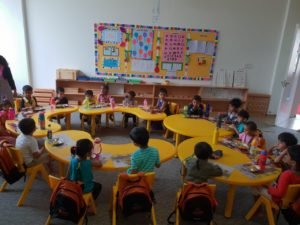
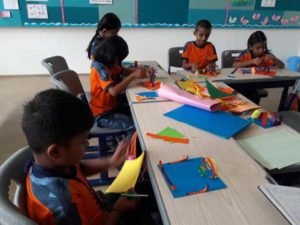
Abstract concepts demand tangible exploration. We integrate inquiry-based learning activities into every daily curriculum. Architecture plays a vital role in this process through our signature U-shaped classrooms.
The Impact of Spatial Design on Thinking
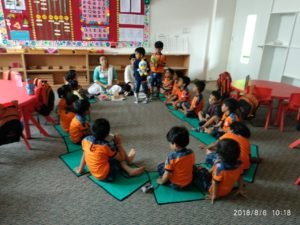
Architecture dictates interaction. Our U-shaped classrooms remove traditional hierarchies, positioning teachers as facilitators within the student circle. Every learner holds an equal visual and vocal presence.
This layout demands active participation. It naturally encourages peer-to-peer dialogue and collaborative questioning, ensuring no student remains a passive observer.
The Teach to Learn Philosophy: 90% Retention
Peer teaching reinforces child-led inquiry. Skalvi operates on a proven cognitive principle: if you teach what you learn, you retain approximately 90% of the information. This is our ‘Teach to Learn’ methodology.
Students sort answers together and take direct responsibility for their education. This reciprocation of concepts transforms the classroom into an active laboratory of ideas where self-motivation replaces external pressure.
Building a Scientific Temperament for Life Beyond Academics
As students progress, their questions evolve in complexity. Our Middle and Secondary programs inculcate a rigorous scientific temperament that prioritizes evidence over textbook repetition.
Students learn to analyze variables and test hypotheses directly. This exact rigor prepares them to lead and adapt in any environment, ensuring they are equipped for the realities of life beyond academics.
Frequently Asked Questions
What is child-led inquiry?
Child-led inquiry is a student-driven method where learners drive their education by framing questions and investigating topics. It replaces rote memorization with active problem solving and critical thinking skills.
How does inquiry build a scientific temperament?
Inquiry forces students to rely on evidence rather than assumptions. By formulating hypotheses and testing variables, students naturally develop the analytical skills required for scientific thinking.
What are inquiry-based learning activities?
These are interactive exercises like peer teaching, U-shaped debates, and hands-on experiments. They require students to collaborate and discover answers collectively, reinforcing deep conceptual retention.